Deep Cycle Battery Fundamentals
What Is a Deep Cycle Battery?
When the grid fails in South Africa, a battery isn’t a luxury, it is a necessity. A starting battery delivers a brief, violent surge of energy to crank an engine. A deep cycle battery, however, is a quiet workhorse, engineered to provide a steady, sustained current over many hours. The difference lies in the internal architecture: deep cycle units use thicker, denser plates that resist the physical degradation caused by repeated, profound discharges.
This tolerance for deep discharge is the defining characteristic. You can regularly draw a deep cycle battery down to 20% of its capacity without causing permanent damage. For solar installations and caravanning, this resilience translates into dependable power. A 100 amp hour deep cycle battery, for instance, provides a tangible reservoir of electricity, running appliances or lighting for extended periods. The key traits to remember are:
- Robust plate construction for longevity
- Engineered for repeated, deep discharge cycles
- Delivers steady current, not a high surge
It isn’t a starting battery that simply tolerates an occasional flattening. It is a storage medium built for the long, slow burn of off-grid living. Understanding this fundamental purpose changes how you select and treat your power source.
Deep Cycle vs. Starter Battery
A starter battery is a specialist in short, violent bursts of energy. Ask it to provide a steady current for a few hours and you will be shopping for a new battery. Deep cycle batteries take the opposite approach. They are engineered with thick, dense plates that tolerate deep discharges without internal crumbling. This makes them ideal for solar and caravan use, where the load is constant, not dramatic.
The true test comes when you misunderstand their roles. If you fit a starter battery into an off-grid system, expect a short, expensive life. If you use a 100 amp hour deep cycle battery to start a car, it will do the job, but it will not enjoy being misidentified as a surge machine.
Here is the practical difference in plain language:
1. Starter battery: huge current, tiny stamina.
2. Deep cycle battery: modest current, substantial stamina.
3. 100 amp hour deep cycle battery: enough stamina to run a fridge for several hours, depending on the load.
Common Battery Chemistries
The chemistry inside a 100 amp hour deep cycle battery determines how many cycles it survives and how deeply you can discharge it without damage. Flooded lead-acid remains the budget workhorse, yet AGM and gel variants offer sealed, maintenance-free operation. Lithium iron phosphate has shifted the landscape entirely. It delivers lighter weight, faster charging, and a usable capacity that often doubles the effective amp hours of lead-acid.
Common chemistries at a glance:
– Flooded lead-acid: affordable, requires ventilation, prone to stratification.
– AGM: sealed, vibration-resistant, ideal for mobile installations.
– Gel: slow discharge rates, sensitive to overcharging.
– LiFePO4: high cycle life, stable voltage, integrated battery management systems.
The trade-offs are significant. Lead-acid tolerates shallow discharges well, but a 100 amp hour deep cycle battery in lithium chemistry can be discharged to 80% or 90% regularly. That translates into more usable power from the same nominal capacity.
Anatomy of a 100Ah Battery
Voltage and Capacity Explained
An often-overlooked truth is that a battery’s voltage is a display of its mood, not a fixed constant. A 100 amp hour deep cycle battery with a nominal 12V rating actually rests near 12.8V when fully charged, and this figure drops towards 10.5V as the cells deplete. Capacitors store charge, but batteries perform chemistry. This means the voltage curve is not linear, so you cannot simply guess the remaining energy using one quick reading.
To read a 100 amp hour deep cycle battery accurately, you need to understand its state of charge under load. A resting voltage of 12.2V usually indicates about 50% capacity, but only if the battery has been still for several hours. Checking the voltage directly after a heavy discharge offers a false reading, as the surface charge inflates the numbers. For solar installations in Johannesburg or off-grid cabins in the Cape, this nuance matters.
Here are the voltage thresholds for a 12V system to remember:
– 12.7V or higher equals 100%
– 12.4V equals roughly 75%
– 12.2V equals 50%
– 11.9V equals 25%
– 10.5V equals complete discharge.
This resource is a reservoir of energy, which means that drawing 20 amps for one hour removes 20 amp hours from the total. However, that loss is never perfectly linear because the Peukert effect influences lead-acid versions. A 100 amp hour deep cycle battery will surrender fewer usable amp hours when you drain it quickly versus slowly. Losing 10% of its theoretical capacity due to high draw rates is common, so plan your loads accordingly.
Amp-Hour Ratings and Real-World Performance
A 100 amp hour deep cycle battery rarely delivers 100 amp hours. That rated number comes from a 20 hour laboratory discharge, a pace most appliances ignore. Inside the case, lead plates and electrolyte produce current through chemical reactions, but the actual output depends on the discharge rate.
Consider the Peukert effect! This battery might deliver only 85 amp hours when you draw 50 amps continuously. That is a limitation, not a defect.
Factors that shift real performance:
- Temperature swings in Gauteng winters
- Depth of discharge cycles
- Internal resistance from corroded terminals
Each factor changes the available capacity. To get genuine amp hours, treat the label as a reference point.
Depth of Discharge and Cycle Life
There is a quiet calculation at the heart of every battery purchase, and the numbers are not always forgiving. A 100 amp hour deep cycle battery is built around thick lead plates, a design that prioritises longevity over raw punch. These plates resist the physical warping that plagues thinner starter battery grids. The trade-off is a heavier block, but the structure allows the cell to shrug off repeated depletion without shedding active material.
The true enemy of this internal assembly is not age, but how deeply you drain it. Depth of discharge, or DoD, determines how many times the chemical matrix can rebuild itself. A battery cycled to 50% and recharged has a far longer service life than one routinely dragged down to 20%. Manufacturers test this with a standardised chart, often revealing a direct correlation between withdrawal and wear.
– 50% DoD: roughly 1000 to 1500 cycles
– 30% DoD: roughly 1800 to 2200 cycles
– 80% DoD: roughly 500 to 700 cycles
Sustaining a shallow drain leaves more lead sulphate in a reversible state during charging. Pushing past that threshold hardens the crystals. This sulfation permanently obstructs the porous plate surface. For a solar setup in the Karoo, where cloud cover forces deeper draws, that ratio becomes a survival metric. Respecting the cycle life means treating the 100 amp hour deep cycle battery as a reservoir with a finite number of refills.
Key Terminals and Dimensions
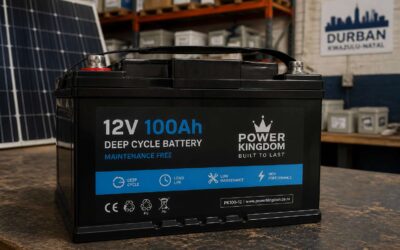
A 100 amp hour deep cycle battery is a study in measured proportions. The standard box sits at roughly 330mm long, 170mm wide, and 220mm tall, a footprint that fits most caravan trays and solar enclosures. That size comes with a weight near 26 kilograms, a direct result of the thick plates and dense electrolyte inside. Everything about the casing is a compromise between portability and the structural integrity needed to survive a rocky trail or a corrugated farm road.
The terminals demand attention before installation. The most common configurations are:
– SAE post terminals, which offer a universal fit for automotive clamps.
– Brass insert terminals, which accept a bolt and provide a more secure, corrosion resistant connection.
– Stainless steel studs, which suit permanent installations where vibration is a concern.
The internal assembly matters more than the label on the side. The terminal posts connect to a cell strap that runs through the lid, and the quality of that seal determines how well the battery handles temperature swings. A weak seal invites acid creep, which eats into the cable lug and leaves a white crust that interrupts the flow of power. A proper battery box with a hold down bracket keeps the case from flexing, preserving the bond between plates and terminals. The dimensions give you the physical space, but the terminals decide how reliably that energy reaches your inverter.
Weight and Portability Considerations
If the external dimensions define where a 100 amp hour deep cycle battery fits, the internal architecture defines its character. That 26 kilogram weight is not an accident of packaging. It is the consequence of pouring energy storage capacity into a mobile format. The thick lead plates, the dense paste that coats them, and the volume of electrolyte required for sustained discharge all contribute to a mass that demands respect. Lifting one by its handle, if the casing includes one, immediately communicates the difference between this unit and a standard cranking battery.
Portability is a study in deliberate effort. A 100 amp hour deep cycle battery pushes the comfortable threshold for manual handling, especially for an off-road enthusiast loading a utility vehicle before sunrise. The weight concentrates low in the casing, which makes it awkward to carry without a firm grip. This physical density is the price for the ability to power a camping fridge for days, but it forces a practical consideration. You must plan the battery’s location before installation, not after, because moving it repeatedly will test your patience and your back.
The internal construction also explains why rough handling matters. The plates and separators inside rely on a controlled environment. Jarring impacts can cause the active material to shed from the plates, which eventually collects at the bottom of the cell and reduces capacity. Consider these points when managing the battery:
– A dedicated carry strap or a purpose built trolley saves strain during installation.
– The case handle, when present, is for lifting, not for supporting the full load over a distance.
– Always lift with your legs and keep the battery upright to prevent electrolyte spillage.
That physical mass also requires a secure mounting system. A loose 100 amp hour deep cycle battery becomes a dangerous projectile in an accident and the constant jostling will shorten its lifespan. Spending the extra money on a quality battery box with a ratchet strap is the sensible move for anyone who ventures off the tar. The weight is a feature, a sign of the robust components inside, but it is a feature you must manage with foresight.
Top Applications for 12V 100Ah Batteries
RV and Camper Van Power
Over 60% of camper van owners run out of power mid-trip, a common failure. A 100 amp hour deep cycle battery prevents that. In my van, it runs a 12V fridge, water pump, and LED lights for two full days. The capacity is predictable, not flashy.
For a South African road trip, this battery powers your devices and keeps food cold. A solar panel can refill it, but the battery alone holds enough for a weekend. Here’s what it handles:
– 12V compressor fridge for 20 hours
– Interior lights for 5 nights
– USB charging for phones and tablets
– A small DC fan
That list covers the essentials. Whether you park in the Karoo or near the coast, this battery turns a camper van into a reliable home.
Marine and Trolling Motor Use
Saltwater is unforgiving. It attacks terminals, housing, and connectors without pause. The 100 amp hour deep cycle battery was built for this environment. It delivers steady current to a trolling motor without the voltage drop that weakens starter batteries.
Anglers working the Breede River or the Knysna coastline understand this. A trolling motor draws 20 to 30 amps at full throttle. That translates to three or four hours of continuous run time, or a full day of short bursts. The same battery powers:
- Fish finders and chartplotters
- Navigation lights and anchor lights
- Bilge pumps and live well aerators
Sealed terminals and vibration resistance matter offshore. The 100 amp hour deep cycle battery offers both, along with roughly 25 kilograms of weight that you trade for reserve capacity.
Solar Energy Storage Systems
Solar panels capture the sun, but a 100 amp hour deep cycle battery holds it for after dark. This battery transformed my off-grid setup in the Karoo. Morning light charges the bank; evening draws it down to power fridges, lights, and WiFi routers without a flicker. Load shedding in Johannesburg makes this battery a practical necessity.
Consider the arithmetic! A 300 watt solar array yields around 25 amps on a clear day. That fills the 100 amp hour deep cycle battery in four hours. Then you transfer that stored power to evening consumption. No grid dependency, no generator noise. The steady discharge curve suits daily solar cycling better than any cranking battery. For a small cabin or a townhouse backup, this unit delivers reliable off-grid power.
Backup Power for Off-Grid Life
The low hum of a neighbourhood inverter is the sound of modern South African anxiety. When municipal power falters, homes fall silent, but a 100 amp hour deep cycle battery holds the line. This is not about solar harvesting in the bushveld; this is about unwavering resilience in the suburbs of Pretoria or a farmstead outside Ceres. I have watched my own unit stand sentinel through the long, dark evenings of winter, a silent guardian for a chest freezer packed with venison and a router keeping my line to the world open. It is the quiet enforcer of your routine.
This stored energy supports more than just fridges. It births a new kind of domestic independence.
– A small water pump for a borehole, keeping troughs full for livestock.
– LED lighting circuits that turn a dark garden into a secure, watchful space.
– Recharging points for radios, laptops, and medical devices like CPAP machines.
Each draw on the stored power is a small victory against the grid’s tyranny. The steady, sustained flow is designed for this nightly ritual, unlike the harsh burst of a starter battery. For a family in a townhouse complex, this battery transforms a moment of crisis into just another quiet evening, a testament to preparation in a land where certainty is a luxury.
Charging Guidelines and Maintenance
Selecting the Right Charger Profile
Overcharging a 100 amp hour deep cycle battery can cut its service life by up to 50%. That silent killer often stems from using the wrong charger profile. A standard automotive charger will push voltage too high, causing gassing and grid corrosion. You need a charger designed for deep cycle chemistries, specifically one with a multi stage process. It should start with a bulk phase, then move to an absorption phase, and finally taper to a float voltage. For most flooded lead acid units, that float sits around 13.5 to 13.8 volts.
Temperature also dictates the correct voltage. In a hot South African summer, a 100 amp hour deep cycle battery needs a lower absorption voltage to prevent thermal runaway. In winter, it needs a higher one to achieve a full charge.
– Check the electrolyte levels monthly if you have a flooded battery.
– Use distilled water only.
– Clean the terminals with a wire brush to prevent voltage drop.
An equalisation charge, performed every few months, can also help balance individual cells. This deliberate overcharge reverses sulfation, but only do it if your battery is not sealed. The operator’s attention matters. Your 100 amp hour deep cycle battery will return the favour with reliable cycles, but only if you treat its charging needs with respect.
Understanding Charge Stages
A 100 amp hour deep cycle battery whispers its health through voltage, but only if you know how to listen. The bulk charge stage pushes current hard until voltage climbs to the absorption threshold. Then the charger holds voltage steady while current tapers. That transition marks the difference between a full charge and a false one. Most failures begin when an owner mistakes a rapid surface charge for genuine capacity.
During float, voltage drops to a maintenance level, yet many ignore the shift. A battery stuck in absorption will overheat and vent corrosive gas. Monitor the charger’s display or use a multimeter to confirm each stage. Your battery’s lifespan depends on catching these quiet warnings early.
- Check voltage at rest after 12 hours.
- Inspect water levels after equalization.
- Record stage durations for anomalies.
These steps reveal hidden sulfation before it steals capacity. A disciplined eye turns a routine charge into a survival ritual.
Cleaning and Inspection Routines
Under a heavy inverter draw, a 100 amp hour deep cycle battery pushes 100 amps through a terminal post. A layer of oxide adds resistance, and resistance turns current into heat. That heat accelerates corrosion, ending in failure before rated cycles.
Set the charger to 10 amps for a standard routine, or 20 amps when time is short. Never exceed 30 amps on a flooded unit. Temperature compensation is essential in South Africa’s heat; a charger set for 25°C will overcharge a battery at 35°C!
Cleaning matters as much as charging. Dirt on the casing forms a conductive film that drains the battery. Wash with diluted baking soda, rinse with plain water, and remove grey-green corrosion from terminals with a wire brush. Tighten cables to torque specs.
Inspect monthly:
1. Terminal torque after temperature swings.
2. Casing for cracks.
3. Vent caps for blockage.
4. Cable insulation.
A clean connection preserves the capacity of a 100 amp hour deep cycle battery.
Storage and Winterization
There is a rhythm to charging a 100 amp hour deep cycle battery, and it is not a drum you can skip. For flooded lead acid units, the sweet spot sits between 10 and 20 amps. South African heat demands temperature compensation on the charger. A unit calibrated for 25°C will cook your battery at 35°C, boiling off electrolyte and warping plates.
Chargers with a smart profile handle the stages for you. Bulk, absorption, and float each have a job. The absorption stage is where the battery rebuilds its chemical resilience, and cutting that stage short steals capacity. A proper routine extends the life of a 100 amp hour deep cycle battery beyond what the label claims.
A monthly inspection keeps trouble at bay. Pressure builds under heavy current, and a loose terminal is a hot spot. Check these items:
The cold months might slow down solar yield, but your battery still needs attention. Store it fully charged, since a discharged plate sulfates fast. Recharge a 100 amp hour deep cycle battery when voltage drops below 12.4 volts. A maintenance charge every eight weeks prevents the crystalline buildup that kills capacity. Your battery is a machine, and machines demand routine.
Safety and Handling Tips
Charging a 100 amp hour deep cycle battery demands attention to environment as much as equipment. South African summer heat raises internal pressure, so charge in a shaded, ventilated space. The gas released during the bulk phase is flammable, and a loose connection can produce the spark that lights it.
Handling rules protect both the battery and the person:
1. Connect the positive terminal before the negative.
2. Lift with a proper strap or the molded handles, never the terminals.
3. Keep metal tools away from the top of the casing.
4. Inspect the casing for cracks before each charge.
The 100 amp hour deep cycle battery is forgiving when treated with order. Secure it firmly in its mounting, because vibration loosens internal plates over time. That mechanical wear shortens lifespan more than any charge curve will, so restraint matters as much as current.
How to Choose Your Battery
Compare Lead-Acid vs. Lithium
Choosing between lead-acid and lithium forces an honest accounting of your habits. A 100 amp hour deep cycle battery holds the same nominal energy in either chemistry, but the usable portion changes. Lead-acid loses cycle life if you regularly go past 50 percent depth of discharge. Lithium tolerates 80 percent without complaint. I have watched too many buyers ignore this difference.
Weight matters too. Lead-acid versions often exceed 30 kilograms. Lithium units stay under 15. The price gap is real, yet the lifecycle gap is wider.
- Lead-acid: lower initial cost, heavier, around 500 cycles.
- Lithium: higher upfront price, lighter, over 3000 cycles.
Your decision reveals whether you plan for next season or next decade.
Assess Your Daily Energy Demands
Most battery purchases fail at the maths stage. Before committing to any battery, calculate your actual daily consumption. Write down every device you intend to power and the hours it runs. The gap between what you think you need and what you actually draw is where most battery decisions go wrong.
Typical draws for a small off-grid setup:
- LED lights: 0.5 to 2 amps
- 12V fridge: 3 to 6 amps
- Phone and laptop: 2 to 4 amps
Add them up, then multiply by use hours. If your number sits around 40 amp hours per day, a single 100 amp hour deep cycle battery leaves little margin when load shedding stretches past your estimate. That reality check changes your choice far more than brand loyalty ever will.
Verify Physical Fit and Connections
Once your daily draw is calculated, the next obstacle is physical reality. A 100 amp hour deep cycle battery carries considerable mass, and dimensions vary wildly between brands. The battery tray in your bakkie was sized for a specific footprint, so measure first, with a ruler, not a hopeful glance.
Connections demand equal scrutiny. Terminal types range from posts to threaded inserts. Consider the following when verifying your setup:
- Terminal post diameter and type, since adapters add resistance.
- Distance to your charge controller, which affects cable gauge.
- Orientation in the compartment, keeping terminals accessible.
Loose connections generate heat, and heat damages batteries. Tighten terminals with the correct spanner, never pliers. Check that cables are long enough without being slack enough to chafe. A poor fit undermines even the finest 100 amp hour deep cycle battery.
Review Warranty and Brand Reputation
Somewhere in the battery world, a warranty is a promise written in vanishing ink. Many a 100 amp hour deep cycle battery arrives with a 12 month warranty that excludes the exact failures you will encounter. Brands with real staying power publish longer terms and name the claim process in plain language. That clarity separates them from the rest.
Review sections deserve equal suspicion. Enthusiastic five star reviews are inexpensive to manufacture. Patterns in negative feedback tell a truer story, especially complaints about capacity fading after a few months. Warranty fine print separates credible brands from dubious sellers:
– Coverage for capacity loss versus only total failure
– Claim logistics, including who absorbs shipping costs
– The brand’s support footprint in South Africa
Reputation is consistency over years. A 100 amp hour deep cycle battery that survives three summers of loadshedding earns attention. The brand behind it has done its homework.

0 Comments