Battery Chemistry and Construction
Lead-Acid vs. Lithium-Ion
Deep cycle battery technology splits into two chemistries: lead acid and lithium ion. Lead acid builds plates from lead alloys, thick and forgiving. Lithium ion stacks oxide cathodes with graphite anodes, demanding exact assembly. Construction reveals their personalities.
- Lead acid tolerates rough handling but packs weight
- Lithium ion cycles efficiently yet requires protection circuitry
I have opened both types! The lead acid interior feels heavy and honest. Lithium ion cells feel precise, almost fragile. Each chemistry solves energy storage differently. Your choice depends on the load profile and temperature, not on brand names.
Plate Design and Active Materials
Plate design determines how long a battery survives repeated discharge. Thick plates, sometimes exceeding four millimetres, carry more active material and resist the swelling that comes with deep cycling. Thin plates generate higher currents but shed material faster.
Active materials do the work. Lead dioxide and sponge lead, pasted onto grids, convert chemical energy through every cycle. The grid alloy matters as well. Antimony and calcium each shape how deep cycle battery technology handles corrosion and water loss.
- Plate thickness improves cycle life
- Grid alloy controls corrosion
- Paste density affects capacity
Manufacturers fire the paste under precise humidity and temperature. The cure determines adhesion. A poorly cured plate crumbles. A well built one holds its charge for years.
Electrolyte Types: Flooded, Gel, and AGM
I have seen many batteries fail simply because the electrolyte was mishandled. Flooded units use liquid acid, demanding distilled water top ups, particularly under South African heat. Gel cells thicken the acid with silica, preventing spills and resisting electrolyte loss during deep cycles. AGM batteries soak the acid into a fiberglass mat, creating a sealed unit that needs no watering.
Here is a practical comparison for your setup:
- Flooded: lowest upfront cost, but you must check fluid levels often.
- Gel: robust against vibration, but charge slowly and dislike high voltages.
- AGM: recharges quickly, handles cold starts well, and stays safe indoors.
Your decision on deep cycle battery technology comes down to ventilation and inspection. A flooded battery in an unopened cabinet can emit hydrogen. Gel or AGM removes that hazard. Choose carefully, I assure you!
Performance Characteristics and Durability
Depth of Discharge and Cycle Life
A battery’s cycle life is not a fixed number. It shifts with depth of discharge, the percentage of stored energy you drain before recharging. Push deep cycle battery technology to 80% discharge regularly and you will see a noticeable drop in total cycles. Stay around 50% and you extend the useful years.
Rated cycle counts assume shallow cycling. Real-world usage rarely matches those lab conditions. The difference shows up in your maintenance budget!
- Heavy discharge accelerates corrosion on the positive plates.
- Heat from deep cycling breaks down the electrolyte faster.
- Partial state of charge allows sulfation to form on lead plates.
Voltage Curves and State of Charge
Read voltage too soon after charging and you see surface charge, not truth. That false elevation can sit a full volt above the cell’s real potential. Leave the battery for six hours, or run a small load for a minute to erase that layer.
Under load, voltage sags. A cell resting at 12.6V may dip to 11.9V under a 10A draw, and the dip’s width exposes internal resistance. As deep cycle battery technology ages, corrosion and sulfation thicken that resistance, so the sag deepens every season.
- Steep sag under constant load: rising internal resistance.
- Resting voltage settling low after full charge: capacity loss.
- Divergence between cells in one bank: uneven wear.
Temperature bends every curve. In a South African summer, voltage falls about three millivolts per degree above 25°C. Deep cycle battery technology ships with a standard calibration, but local heat rewrites it. Readings under different temperatures are not comparable.
Capacity Ratings and Discharge Rates
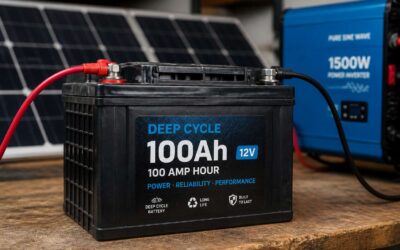
A 100Ah battery rarely delivers 100Ah. Manufacturers rate it over a 20 hour draw, so 5A empties the pack exactly on schedule. Increase the load to 25A, and usable capacity may fall to 70Ah. Peukert’s law describes this loss, and it applies to lead plates and lithium cells alike. Deep cycle battery technology hides its real performance behind those numbers.
Published ratings are printed at specific discharge windows, and each one shifts the result:
- C20: the standard 20 hour reference.
- C10: a faster draw used for solar and marine work.
- C5: a short burst that exposes limits.
Durability follows the same rhythm. High discharge rates accelerate capacity fade by stressing the battery’s internal structure. In South Africa, load shedding turns a steady draw into a series of irregular pulses. A bank sized for 100Ah rarely survives many evenings at a heavy 25A pull.
Temperature and Environmental Impact
Heat quietly shapes how your battery behaves. In Gauteng summers, a battery box can hit 40°C, and every 10 degrees above 25°C halves expected life. Deep cycle battery technology relies on stable chemical reactions, yet high temperatures speed up corrosion and water loss. Cold snaps, though rare, slow ion flow and drop apparent capacity. Environmental factors include:
- Dust blocking vents and insulating the casing
- Humidity and salt spray accelerating terminal corrosion
- Vibration from poor mounting, loosening internal plates
These stressors pile onto the strain of irregular load shedding patterns. I have watched a battery survive one harsh season, then fail the next. In coastal cities like Durban, airborne chloride compounds attack lead plates directly. Meanwhile, indoor installations face dust and poor airflow, baking the cells slowly. Temperature and environment decide real-world durability, not just the sticker on the side.
Charging and Maintenance Best Practices
Multi-Stage Charging Profiles
The charging phase determines how long a battery survives. Most premature failures trace back to poorly managed charge cycles, not old age. Multi stage charging profiles sequence current and voltage in deliberate steps. Bulk charging pushes maximum current until voltage hits a threshold. Absorption then holds that voltage while current tapers off. Float supplies a small trickle to counter self discharge. Some chemistries benefit from an equalization stage to balance cells.
These stages serve a purpose! They reduce sulfation and prevent thermal runaway. A typical profile includes:
- Bulk: constant current, recovers most capacity.
- Absorption: constant voltage, finishes the charge.
- Float: low voltage, maintains readiness.
Proper maintenance includes checking terminal connections and setting the charger to the correct voltage. A mismatched profile causes permanent capacity loss. In South Africa, where off grid systems are common, a quality charger paired with your deep cycle battery technology prevents avoidable damage.
Absorption, Float, and Equalization
Absorption demands patience. The battery has recovered most of its energy, yet the final portion requires a steady voltage while current tapers on its own. Rushing this stage is a quiet act of sabotage. Float is different. It maintains readiness against self discharge, but it cannot compensate for a neglectful owner.
Equalization pushes further, deliberately overcharging cells to correct imbalances. For off grid South African systems, this discipline is everything. Deep cycle battery technology behaves predictably when the charge curve is honoured. Consider what each stage actually protects against:
- Absorption prevents undercharged plates
- Float stops prolonged idle stress
- Equalization corrects cell drift
Skip them, and the capacity loss is yours to own.
Battery Management Systems
Deep cycle battery technology rewards the vigilant. In South Africa’s erratic grid, a battery management system serves a critical function. It tracks voltage, current, and temperature, and it warns you before failure sets in. Relying on visual checks alone invites hidden degradation.
Maintenance demands routine. Clean terminals, torque connections, and measure specific gravity when your bank allows. The BMS does the deeper work, logging cycles and flagging drift you would miss. That data becomes your record. I have seen banks fail from neglect, from owners who stopped looking.
A proper system handles these tasks:
- Monitor individual cell voltages
- Communicate alarms for overcurrent or overtemperature
- Record charge history for later review
Deep cycle battery technology punishes the inattentive. The charge curve matters, and so does the data trail around it. Heed the warnings, and the bank endures.
Cell Balancing and Monitoring
In a series string, the weakest cell determines the entire bank’s usable capacity. One low cell makes the charger see full voltage early, while the rest stay underfilled.
Cell balancing corrects this. Passive balancers burn off excess charge from strong cells as heat; active balancers shift that energy where it is needed. Both methods keep cells aligned through the absorption phase.
Monitoring goes beyond a glance at the display. To see what your cells are actually doing, I recommend:
- Record individual cell voltages under load, not just at rest
- Measure internal resistance to expose developing shorts
- Compare cell temperatures across the string during heavy cycling
These readings expose drift months before a failure becomes obvious. This discipline defines deep cycle battery technology in practice. It turns a collection of cells into a predictable energy system, one you can rely on through extended outages.
Seasonal Storage and Care
Deep cycle battery technology depends on disciplined charging habits to perform across its full service life. A battery left at partial charge develops sulphation on the plates, which permanently reduces capacity. Consistent full charge cycles, even during light use, preserve the chemistry and keep the system predictable.
Seasonal storage in South Africa presents distinct conditions. Summer heat accelerates grid corrosion, while cold winter nights lower effective voltage. A battery placed into long storage should start at complete charge. It should remain in a dry, shaded location, with resting voltage checked every few weeks. A refresh charge is required when the voltage falls below the manufacturer’s recommendation.
Routine maintenance covers these checks:
- Tighten terminal connections to the specified torque
- Clean corrosion from posts and cable lugs
- Inspect cables for cracks or worn insulation
These checks expose developing faults before they cause failure. When deep cycle battery technology is paired with proper care, the bank delivers dependable capacity and steady performance through extended outages.
Selecting the Right Energy Storage Solution
Renewable Energy and Solar Applications
South Africa’s residential solar installations grew by 350% in 2024, yet many of those systems will fail before their fifth year. The culprit is rarely the inverter or the panels. It is the storage choice made at installation.
Selecting an energy storage solution for renewable energy and solar applications requires matching the battery to the daily discharge pattern, not just the kilowatt-hour rating. A grid-tied array cycles shallowly each morning, while an off-grid setup must endure deep draws through winter overcast weeks.
- Assess daily energy throughput, not just capacity
- Match cycle depth to seasonal weather patterns
- Verify operating temperature range for South African climates
Deep cycle battery technology rewards those who study their own consumption habits. The correct chemistry and plate configuration follow from that data. Choosing well means understanding how the system behaves on a Tuesday afternoon in July, not on a perfect sunny day. Deep cycle battery technology, matched to real conditions, delivers reliable power through a decade of load shedding and heat waves.
Marine, RV, and Mobile Use
A boat battery that fails off Cape Point isn’t an inconvenience; it’s a safety hazard.
Marine and RV use punishes batteries with constant vibration, heat, and incomplete alternator charging. I’ve seen too many fail this way. Matching deep cycle battery technology to those physical realities determines whether your fridge survives a weekend or dies on the first night.
Consider these realities:
- Alternator charging rarely reaches full absorption voltage, so choose a battery that tolerates chronic partial states.
- Storage in a hull or engine bay can exceed safe temperature ranges, so confirm heat limits.
- Reserve capacity must cover overnight loads without dipping into dangerous voltage territory.
Weight distribution also constrains chemistry. Lithium saves weight but demands specific charging profiles from older alternators. Select your deep cycle battery technology for the worst road and the roughest sea, not the showroom spec sheet.
Industrial and Material Handling
The warehouse floor does not forgive hesitation. A pallet jack that dies mid-shift halts the entire chain of dispatch. Selecting the right energy storage solution for industrial and material handling begins with mapping the duty cycle, not the brand name.
Deep cycle battery technology must endure three-shift rhythms. The demands differ from leisure or marine use:
– Opportunity charging during short breaks requires chemistries that absorb partial charges without damage.
– Forklift lifting cycles pull high discharge currents, so voltage stability matters more than raw capacity.
– Dock floor ventilation may restrict certain electrolyte types, limiting your practical choices.
Fleet managers often calculate cost over the battery’s total lifespan, yet the real variable is operational uptime. A unit that performs for six hours under continuous load outperforms one that only reaches that figure in the brochure. Match the energy storage to the actual workflow, and the rest follows naturally.
Comparing Costs and Total Ownership
Diesel back-up generators in South African warehouses burn roughly 4 litres per hour, yet the battery bank behind them often carries the bigger invoice over time. Total ownership of deep cycle battery technology extends beyond the purchase price. The real costs appear in charging efficiency, replacement frequency, and maintenance labour.
Compare two options side by side:
- Cycle life at 50 percent discharge, not the brochure figure
- Charge acceptance during partial states of charge
- Voltage sag under sustained load
In my years on the floor, I have watched cheaper batteries cost companies twice as much. A battery that sags in voltage shortens the life of driven equipment. In South Africa’s fluctuating grid, the unit that accepts partial charges without damage saves more than the one with a lower sticker price. The math of ownership rarely favours the cheapest upfront option.
Sizing and Capacity Planning
Sizing a battery bank demands brutal honesty about your daily energy draw! I see warehouses spec a 100Ah bank for a 20A load and wonder why voltage collapses by three in the afternoon. Capacity planning is arithmetic, not a guess.
First, define your daily kilowatt hours. Second, multiply by worst-case days of grid failure. Third, account for the charging source. A generator running four hours cannot refill twenty hours of load. Deep cycle battery technology only serves the system you build around it.
- Peak load versus average load
- Temperature derating for a Joburg winter
- Charge efficiency losses, often fifteen percent
Each number shifts the final size. Ignore them and pay twice!
Future Trends in Battery Technology
Choosing the right energy storage solution requires a clear view of your current needs and a measured guess about tomorrow. South Africa’s grid remains unpredictable, so the technology we select today will either stretch or shrink our options later. Deep cycle battery technology is evolving quickly, and the next decade promises quieter, denser, and more intelligent systems.
Consider the shifts on the horizon:
- Solid state designs that reduce fire risk.
- Sodium ion cells that lower dependence on imported lithium.
- Software driven BMS that learn from your usage.
Each trend changes the economics of storage. The wise buyer watches them with patience, not speculation. Let the technology mature, then choose the solution that fits your actual load profile.

0 Comments